|
 |
 |
|
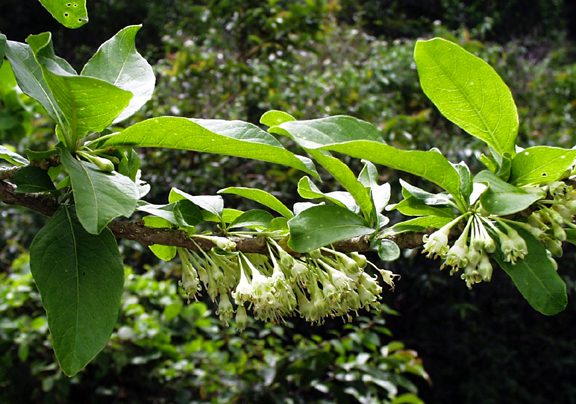
habit with flower |
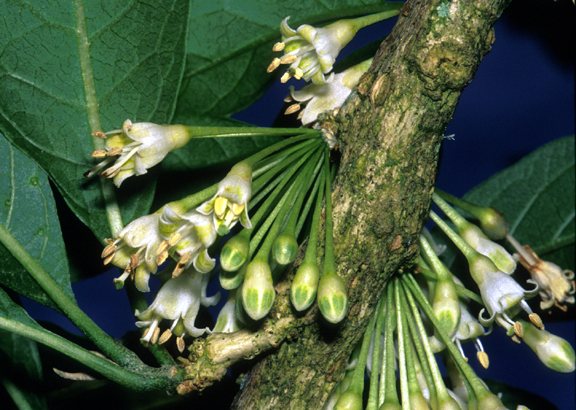
flower |
Acnistus arborescens (L.) Schltdl.Solanaceae - Potato Family |
|
|||||
|
|||||
|
Description. Small to medium-sized tree, reproductive at 2-10 m; bark beige, corky with deep virtical ridges and fissures; leaves alternate, often not paired, to 25 cm long, glabrous, elliptic, entire, often with small wart-like galls; flowers white in dense fasciles in leaf axils or at leafless nodes, bell-shaped, 1 cm long, with 5 recurved lobes, green-spotted inside, anthers cream, fragrant; fruit a 7 mm orange juicy berry with many small flat seeds. Similar species. Because of its habitat and distinctive features, this species is hard to confuse with any other tree. Local distribution. Common in disturbed areas from 700 to 1500 m on the Pacific slope; rarely cultivated on Atlantic slope. Habitat. Open areas such as roadsides, old pastures, and young secondary forest. Species range. Mexico to Costa Rica; Ecuador and Peru. Abundance. Common at 1000-1400 m, less abundant at higher and lower elevations. Phenology. FL: may-jun; FR: may-sep. Some individuals can be found in flower at any time.
Herbivores. Ithomia heraldica, Ithomia xenos Pollinators. Small insects including bees, wasps, flies, butterflies, beetles, and ocasionally hummingbirds. Seed dispersers. The fruits are eaten by more than 40 species of birds. Comments. Lacks the tomato leaf odor characteristic of many solanaceous species. Most individuals have at least some leaves with small wart-like galls. Voucher. Haber 462 |
|